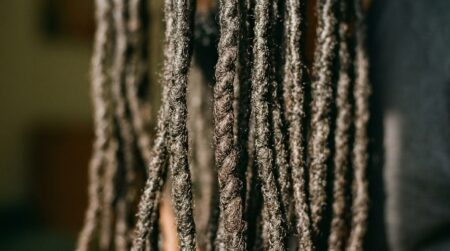

J Cole’s dreads are the cleanest case study in modern hip-hop for what real freeform locs look like after a decade of zero manipulation. He started his loc journey in 2013, right after the release of his second album Born Sinner, and has never publicly retwisted, palm-rolled or interlocked his locks. The result, by 2026, is a head of mid-to-long locks that have congoed naturally into thick, irregular shapes that contradict almost every rapper-with-dreads aesthetic. If you searched “J Cole dreads” looking to copy the look, the honest answer is that you cannot rush it: his locks are 12+ years of patience made visible.
Table of Contents
- Who is J Cole and why his dreads are different
- J Cole dreads timeline: 2013 to 2026
- The J Cole dread method: what freeform actually means
- How to get J Cole-style dreads on your own hair
- J Cole dreads vs other rappers
- Maintenance budget and reality check
Who is J Cole and why his dreads are different
Jermaine Lamarr Cole, born January 28, 1985 on a US military base in Frankfurt, Germany, raised in Fayetteville, North Carolina, has built one of the most independent careers in modern rap. He founded Dreamville Records in 2007, won a Grammy with the J-i-d / 21 Savage collaboration era, and released six studio albums while running his own label. The Dreamville Foundation pays the bills for single mothers in his hometown. Most relevant for this guide: he is one of very few major rappers who switched from a clean-cut, low-fade look to fully freeform locks and stuck with the freeform philosophy without ever pivoting back.
J Cole dreads timeline: 2013 to 2026
Pre-2013: the clean-cut era
From 2010 to 2012, during the Cole World: The Sideline Story press cycle and early Roc Nation era, J Cole maintained a low fade with a short top. This was the standard hip-hop short look. No hint of locks. The transition that comes next happens fast, which is unusual.
2013-2014: the baby loc phase
By mid-2013, around the Born Sinner release in June, photos start showing him with a small afro that he has visibly stopped trimming. By late 2013 and early 2014 the first loose curls are forming on top of his head: starter freeform locks. There is no professional installation here, no coil method, no twist-and-rip session at a salon. He simply stopped combing.
2015-2017: the awkward middle phase
Every freeform loc journey has an awkward middle phase, and J Cole’s was on full display during the 4 Your Eyez Only era (2016-2017). His locks at this point are clearly forming but very irregular: some thick, some thin, some short, some longer. This is the phase where most freeform-starters give up. Cole did not. The 2017 Dreamville Festival photos show locks that have congoed into chunkier shapes, particularly at the crown.
2018-2020: the established freeform
By the KOD album release in 2018 and through 2020, the locks have settled into their personality. They are visibly thicker than 2016, length is shoulder to upper-back depending on the lock, and the congos (natural fusions of two or more locks) are pronounced. Cole’s locks at this stage are textbook freeform: irregular sizes, organic shapes, no consistency in diameter, and clearly comfortable with their shape.
2021-2023: peak mature locks
Through The Off-Season (2021) press cycle and into 2023, his locks are now mature: thick, dense, mid-back length on the longest sections. The fade sides have evolved too, kept short and clean while the top stays untouched. This is the J Cole dread silhouette that most people now picture when they hear his name.
2024-2026: the locked-in era
The Might Delete Later (2024) era and recent Dreamville Festival appearances show locks that have stabilized fully. There is no more visible growth in irregularity, just steady lengthening. Some of the longest locks are now approaching lower-back length. By 2026 the journey is 12-13 years old. For context on what dreads look like after several decades, see our piece on what extremely long dreadlocks look like.
The J Cole dread method: what freeform actually means
His locks are the cleanest documented example of true freeform among major rappers. The method, in the literal sense, is: do nothing. The technique that distinguishes Cole’s locks from a freeform-starter who fails is what he did not do.
- No retwisting: most rappers retwist their roots every 3-4 weeks. Cole has never been photographed mid-retwist nor shows the tight, neat root definition that comes with retwisting. The hair grows out as it wants.
- No palm-rolling: palm-rolling smooths the lock cylinder and creates rounder sections. Cole’s locks are visibly flat in places, which is the natural shape when the hair is not palm-rolled.
- No interlocking: another popular maintenance technique that creates tight, defined locks. Cole’s locks show none of the interlock zigzag pattern.
- Manual separation only: he pulls apart congos that get too big, which is the one freeform maintenance step you cannot fully skip. Without separation, the locks fuse into one mat.
- Regular washing: he is clearly washing his hair (no visible build-up, scalp appears healthy in close-up). Freeform does not mean unwashed.
How to get J Cole-style dreads on your own hair
This is the simplest method in the dread world and also the slowest. The full procedure:
- Hair length: minimum 7-10 cm of Type 4 (afro) hair. Looser textures take 2-3x longer.
- Wash with a clarifying, residue-free shampoo to remove all product build-up.
- Stop combing. Stop brushing. Stop conditioning. From this day forward.
- Wash every 7-10 days with the same residue-free shampoo.
- Sleep on a satin pillowcase or with a satin bonnet to reduce friction-induced breakage.
- At month 3-6, you will see clumps forming. Do not panic. Pull apart congos that are larger than a finger thickness.
- Continue this for 18-24 months minimum before the locks look like Cole’s. 5+ years before they look as mature as his current state.
Our full guide on growing freeform dreadlocks naturally covers the philosophy in depth. The single biggest pitfall is impatience: most freeform-starters quit between month 4 and month 8 because the locks look messy. Cole has talked publicly about this phase being part of the journey, and his current locks are proof that the messy middle does in fact resolve into something solid.
J Cole dreads vs other rappers
- Quavo: tightly maintained, retwisted, 100+ uniform locks. The exact opposite philosophy. See Quavo dreads for the contrast.
- Lil Wayne: more freeform than Quavo but still occasionally retwisted. Cole’s locks are looser and more congo-heavy than Wayne’s.
- Bob Marley: the historical freeform reference. Marley followed essentially the same philosophy Cole follows, just for a longer period (over 12 years). See how long Bob Marley grew his dreadlocks.
- 2 Chainz: very long, very thick locks but also more shaped/manipulated than Cole’s. 2 Chainz dreads show what extreme thickness looks like after 20+ years.
- Rappers with dreads in general: Cole is closer to the natural-hair community than to the hip-hop loctician-maintained look. See our roundup of rappers with dreadlocks and how to get them for the broader comparison.
Maintenance budget and reality check
The financial side is where freeform locs win. Cole’s maintenance routine, if he were paying retail, costs roughly:
- Shampoo (residue-free, ~$20 bottle) every 2 months: ~$120/year.
- Satin pillowcase or bonnet: ~$30 every two years.
- Periodic side fade trim (barber): ~$30 every 6-8 weeks = $300/year.
- Optional oil treatment (peppermint, jojoba): ~$60/year.
Total annual cost: roughly $500. Compare that to the $1,200-$2,500/year that Quavo-style maintenance demands. Freeform is the budget loc choice if you have the patience for the longer maturation timeline.
How long has J Cole had dreadlocks?
J Cole has been growing dreadlocks since mid-2013, just after the release of his Born Sinner album. As of 2026, that puts his loc journey at approximately 12-13 years. His locks are now firmly in the mature phase, with the longest sections approaching lower-back length.
Are J Cole’s dreads freeform or retwisted?
J Cole’s dreads are fully freeform. There is no visible evidence of retwisting, palm-rolling, or interlocking in his press photos or music videos. The irregular thickness across his locks, the natural congos (fused sections), and the lack of a tight, manicured root pattern are all hallmarks of freeform locks. His maintenance routine is essentially washing, sleeping on satin, and pulling apart congos that get too big.
How can I get dreads like J Cole?
Stop combing your hair, wash it weekly with a residue-free shampoo, and wait 18-24 months for visible starter locks. Do not retwist, palm-roll, or use any maintenance product. Type 4 (afro) hair will form locks fastest; looser textures take 2-3x longer. The look that resembles Cole’s current state requires 8-10 years of consistent patience. If you want a faster path to looking locked, the coil method or twist-and-rip will get you there in 12-18 months but the locks will not look as organic as his.
Does J Cole’s dreads evolution show his locks getting thicker over time?
Yes, this is one of the clearest visible patterns in his timeline. From 2013 to 2018, the locks gradually congoed (fused) into thicker units. By 2020 the count had reduced from his original 60-80 baby locks to roughly 40-50 mature locks. This congoing is the natural behavior of freeform locks: adjacent locks fuse where they touch most often, particularly at the crown. Quavo’s locks do not congo because his retwist routine separates them every 3-4 weeks. Cole’s locks congo because they are left alone.