A Hairstyle Carved in Stone
Ancient Greek dreadlocks are not the myth many assume them to be. Thousands of years before reggae made locs a global cultural symbol, Greek sculptors were already carving rope-like coils of hair into marble. Kouros statues, Minoan frescoes, vase paintings, and literary accounts by Herodotus himself all point to matted, twisted hair holding deep cultural meaning across the ancient Greek world. We cross-referenced primary historical sources and major museum collections to trace exactly what role ancient Greek dreadlocks played in a civilization that shaped so much of Western history.
Did the Ancient Greeks Really Have Dreadlocks?
The honest answer is yes, though with some nuance. The word “dreadlock” is modern, coined in the 1950s Rastafari movement in Jamaica. What ancient Greeks wore was described using terms like plokamoi (πλόκαμοι), meaning matted coils, or simply depicted visually without specific labeling. What matters is what the archaeological evidence actually shows.
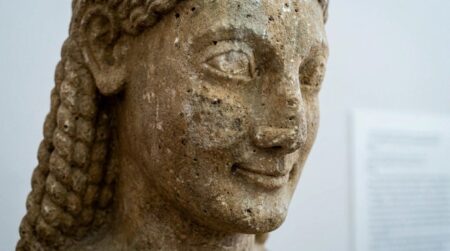
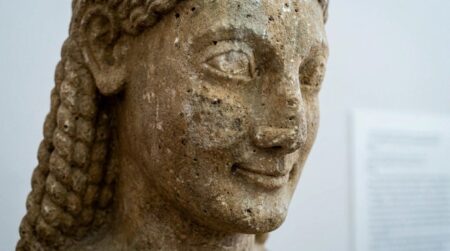
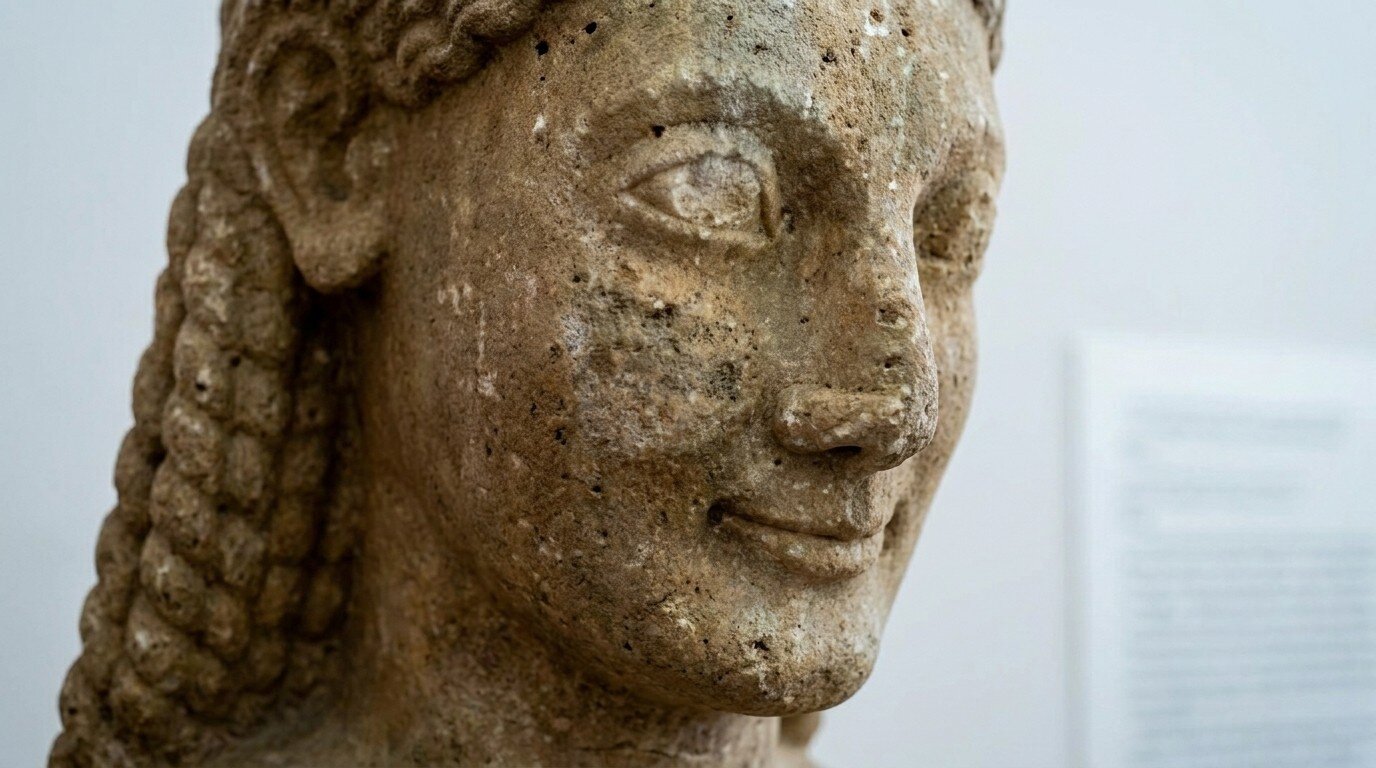
The most compelling proof comes from the Kouroi (singular: Kouros), free-standing marble statues of young men produced between roughly 700 and 480 BCE during the Archaic period. These figures consistently show hair arranged in thick, segmented ropes falling behind the shoulders, strikingly similar to modern freeform dreadlocks. The separation of individual locks and the way they cluster leave little room for alternate interpretation. Sculptors were not depicting braids. The matted, knotted quality is distinct across dozens of surviving examples from different city-states.
Further evidence appears in Minoan art from the island of Crete, predating classical Greece by centuries (roughly 2700–1450 BCE). Wall frescoes at the Palace of Knossos show both male and female figures with thick, twisted rope-like hair. Since Minoan culture directly influenced early Greek civilization, this suggests the practice of wearing matted locks ran deep across the Aegean world long before the classical period began. Understanding this visual tradition connects directly to the true origins of dreadlocks across ancient civilizations — a story that crosses every continent and every major culture on record.
Ancient Greek vase painting adds another layer. Dionysus, god of wine and ecstasy, is consistently shown with loose, wild, entangled hair in both red-figure and black-figure pottery from the 6th and 5th centuries BCE. His hair is not merely disheveled. It has a specific knotted, rope-like quality that vase painters reproduced across generations and across city-states, suggesting a culturally recognized standard of what matted divine hair looked like.
Greek Gods Depicted with Twisted, Matted Hair
In ancient Greek religion, the appearance of a deity communicated meaning. Hair, in particular, signaled status and spiritual standing. Several major figures in the Greek pantheon were consistently depicted with what we would today recognize as dreadlock-like hair, and this was not accidental. It reflected a coherent cultural belief: certain states of the soul, and certain relationships with the divine, manifested visibly through the texture of the hair.
Dionysus sits at the center of this tradition. As the god of altered states and the dissolution of social order, he embodied everything that neatly combed, socially acceptable hair did not represent. His tangled mane appeared in this form across generations of Greek art and theater masks. Wearing your hair in free-form locks in ancient Greece carried an implicit echo of Dionysian freedom, a deliberate signal of distance from the social mainstream.
Medusa offers a more layered case. The snake-hair version familiar from classical mythology was not the earliest representation. Older depictions of Medusa — before the serpentine imagery became standard in the late Archaic period — show her with thick, coiled locks. Scholars have suggested these earlier representations drew on actual Greek hairstyle traditions, gradually transforming natural matted hair into the serpentine imagery that later became her most famous feature. The connection between wild, uncontrolled locked hair and both danger and power was already embedded in Greek visual culture before the snakes arrived.
Asclepius, god of medicine, was another figure regularly depicted with heavily coiled hair and beard. His association with healing and with deliberate withdrawal from ordinary society aligned culturally with hair that showed distance from cosmopolitan life. Even some representations of Zeus in his older, more formidable aspect show rope-like coils rather than neatly arranged waves, reinforcing that within Greek visual culture, matted hair was not poverty or neglect. It was authority.
Those twisted ropes of hair carved into Greek marble aren’t decorative — they’re the earliest stone-cold evidence that locs have always meant something.
Were Spartan Warriors Really Known for Their Dreadlocked Hair?
The Spartans’ relationship with hair is one of the most documented in ancient history, and it connects directly to the question of ancient Greek dreadlocks. The most striking account comes from Herodotus, writing in the 5th century BCE. In Book VII of his Histories, he describes a Persian scout observing the Spartan warriors at Thermopylae before the famous last stand — and finding them calmly arranging and styling their hair. When this report reached Xerxes’ court, the king reportedly found it absurd. Demaratus, the exiled Spartan king advising the Persians, explained that this was what Spartans always did before battle, and that no men in the world were more dangerous.
Spartan men began growing their hair long upon reaching military age, keeping it carefully maintained as a visible mark of status and freedom. Plutarch, writing centuries later, noted that Spartans would “arrange their hair” before combat, citing an old saying that long hair made the handsome more beautiful and the ugly more frightening. This was identity work, not vanity. The hair was the message.
Were Spartan locks exactly what modern people would call dreadlocks? Probably not in every case, some depictions show more braided styles. But the cultural logic is the same: long hair, deliberately maintained, carrying a refusal of civilian softness and a claim to warrior identity. That logic runs unbroken through loc culture today. It is also why Jason Momoa’s long, matted locs as a modern warrior aesthetic land so immediately, without explanation. The hair speaks before the person does.
How Did Ancient Greek Dreadlocks Influence the Rest of the World?
Ancient Greece did not exist in isolation, and neither did its hairstyle traditions. The Mediterranean world of the classical period was a network of trade routes and military campaigns, and hair, as a visible marker of identity, traveled with people through all of it.
Greek contact with Egypt stretched back centuries before the classical period. Egyptian priests of certain temples wore their hair in matted, locked styles, and Greek traders and soldiers encountered these communities regularly. Influence almost certainly ran in both directions. The Fayum mummy portraits — produced in Roman-era Egypt but drawing heavily on the earlier Hellenistic tradition — include numerous individuals with clearly matted, locked hair, suggesting this style had become normalized across the Greek-influenced Egyptian population long before Rome arrived.
Alexander the Great’s campaigns (334–323 BCE) pushed Greek aesthetics deep into Asia Minor, Persia, and the Indian subcontinent. Gandharan sculpture, Buddhist art produced in what is now Afghanistan and Pakistan under strong Greek stylistic influence, frequently depicts the Buddha with rope-like hair coils recognizable as the ushnisha, the protrusion symbolizing spiritual wisdom. Art historians have drawn direct visual parallels between the hair treatment in Greek Kouros statues and the hair conventions of early Gandharan Buddhist sculpture, suggesting that Greek conventions for depicting sacred matted hair directly shaped how Buddhist art represented enlightenment. Most people have no idea this connection exists.
The aesthetic of divinely matted hair traveled eastward through Alexander’s cultural footprint, merging with indigenous traditions across the ancient world. The result was a shared visual language of spiritual authority expressed through locked hair, found across Greece, Egypt, India, and beyond — long before any of these cultures had a word for what they were wearing.
What Ancient Greek Dreadlocks Mean for Loc Culture Today
The history of ancient Greek dreadlocks matters not as a claim of ownership, hair locking has emerged independently across nearly every ancient culture on record, but as evidence of something universal. When someone wears locs today, they are participating in a tradition that connects Spartan warriors, Egyptian priests, Indian sadhus, and Greek gods carved in marble. Greece is one anchor point in that story, and one of the best-documented ones in the Western historical record.
For anyone who wears dreadlocks, this history adds a layer of meaning that modern pop culture rarely provides. Your locs are not a statement of belonging to one subculture. They are a continuation of something that people across every continent and every era have reached toward independently, a way of letting hair speak about identity, spirituality, and the refusal to conform.
The Kouros stands in a museum gallery and you walk past it and the thought arrives: those are locs. Carved in 620 BCE. That continuity does not belong to any one culture. It belongs to everyone who has ever worn them.
Understanding the Roots of Dreadlock History
Ancient Greek dreadlocks are one of the most compelling chapters in the worldwide history of loc culture. Kouros statues, Spartan battle rituals, Dionysus, Gandharan Buddhist art — matted and twisted locks appear again and again as markers of power, devotion, and identity across the ancient Greek world and everything it influenced. No single civilization owns this tradition. It is human. Ancient Greece simply provides one of the richest archaeological records of it in the Western canon. The next time someone asks where dreadlocks come from, Greece is a legitimate answer, backed by marble, paint, and primary sources dating back 2,700 years.
Did ancient Greeks have dreadlocks?
Yes, based on sculptural and artistic evidence. Kouros statues from the Archaic period (700–480 BCE) consistently depict men with rope-like, segmented locks closely resembling modern dreadlocks. Ancient Greek gods including Dionysus were also regularly depicted with matted, twisted locks across centuries of vase painting and sculpture.
What did dreadlocks symbolize in ancient Greece?
In ancient Greece, matted or twisted hair carried multiple meanings. For Spartan warriors, long carefully maintained locks signified freedom, valor, and readiness for battle. In religious contexts, particularly around Dionysus and other gods, matted hair represented spiritual ecstasy, divine power, and liberation from social convention.